CHO Hyesu
January 26, 2026
View the original (Japanese): 記憶の前でーー大阪 鶴橋・西成 フィールドワーク・レコード
This text is translated from the original Japanese. While every effort has been made to preserve the tone and nuances of the source, certain expressions may reflect the original language. Thank you for your understanding.
Last summer, I visited Tsuruhashi in Osaka, one of the largest Koreantowns in Japan. I stopped by while visiting Cocoroom, a community space that has been active there for many years in Nishinari. Nishinari and Ikuno lie diagonally across from each other with Tennoji in between. Although I had been coming to Osaka for some time, it was my first visit to this area.
My first trip to Osaka, on the other hand, was during a high school field trip. We took a ferry from Busan Port, passing through Tsushima, Shimonoseki, and the Seto Inland Sea before arriving at Osaka Port. On board, my friends and I crossed the sea in a lively blur of chatter, eating Shin Ramyun in our cabin. We departed in the afternoon and arrived the next morning after a night’s sleep. From the ship, the sea looked impossibly dark and deep. There was nothing to see. And when I woke up, we had already arrived.
I begin with this story because the same route was used a hundred years ago. I saw a map marking this route at the Koreatown History Museum in Tsuruhashi, which I visited this time. It is likely a path that has been traveled for well over a century. I imagine that my great-grandfather and my maternal grandmother also took this route when they returned to Busan after liberation.
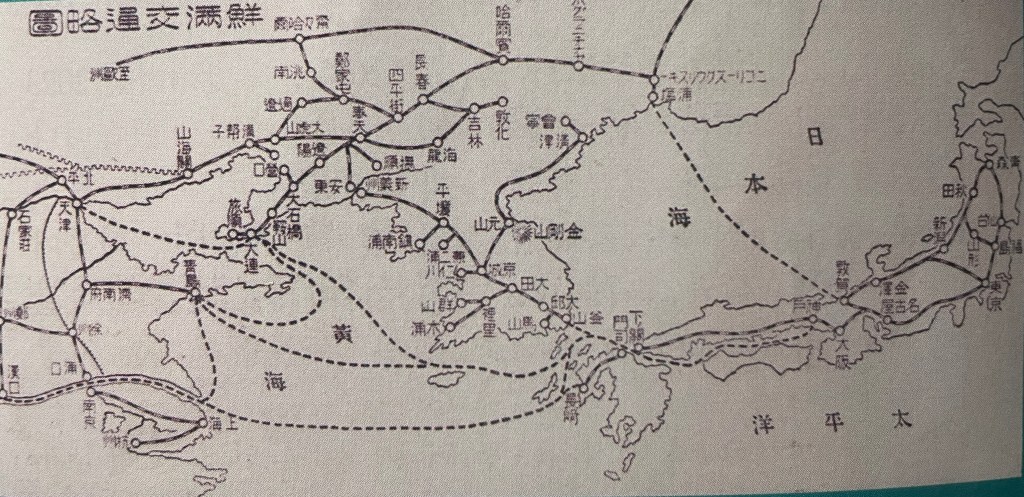
featured in an informational pamphlet from the Osaka Korea Town Museum.
From Busan, the route passes through Shimonoseki, enters the Seto Inland Sea,
and arrives at Osaka Port.
My great-grandfather moved to Japan during the period when the Korean Peninsula was under Japanese colonial rule. I have been told he went there for work, but beyond that, I know very little. He was a coal miner. My maternal grandmother was born and raised in a mountain village near Kyoto, where she eventually settled after passing through Osaka. I don’t know much else about her early life, either. After liberation, she boarded a repatriation ship for Koreans and returned to Busan, before she turned twenty. (Is it possible to “return” to a place one has never once been?)
My grandmother passed away one month before I was born. In other words, there is not a single moment in time that we physically shared. Still, I love the stories I have heard about her. That is why I felt such a quiet pleasent when I came across a sea chart at the Osaka Korea Town Museum in Tsuruhashi.
I think I began to feel curious about her only after I became able to speak Japanese. My mother once thought that, as a child, kaidan—“stairs” (pronounced kedan in Korean)—was part of the Busan dialect. There are a few other stories about my grandmother that I hold dear, and many of them have to do with her language. The one that stays with me most is my uncle’s childhood memory: that my grandmother would always speak in Japanese, but only with the woman who sold tofu at the market. When she first returned to Busan, she couldn’t speak Korean at all.
I am the only one who can understand the words she spoke in those days.
Even though she is no longer here.
My uncle, now an old man, sometimes searches on Google Maps for the address where my grandmother was born more than a hundred years ago, and looks at it on Street View. The address was given to him long ago by my grandmother’s younger sister. She, too, has been gone for many years. One day, my uncle said this:
“I tried to access the Kyoto city archives, but maybe because I am overseas, I could not get in. Maybe we could find her name in something like resident registries or passenger records—you might be able to search for her name there. Japan is a country where old records are still kept.”
I asked for my grandmother’s Japanese name.
“Since her surname was Kim (金)……it was probably read as Kane…something (金⚪︎),’ I think.”
Is it possible to search for a memory you cannot name?
WHAT Remains
If you get off at Tsuruhashi Station in Ikuno Ward and walk for about ten minutes, you arrive in Koreatown.
This area, long known as a Korean enclave since before liberation, was once called Ikaino (猪飼野).
What you see today is mostly Korean specialty shops. It has become a lively street filled with K-pop goods stores and Korean-style cafés, crowded with young people. At the same time, there are shops that look unmistakably like they are run by Zainichi Koreans (Koreans living in Japan, often across generations), preparing and selling side dishes in traditional ways. At one moment, the area feels like an old district such as Jongno—Seoul’s historic center, known for its traditional markets and long urban history; at another, it is as noisy and energetic as Hongdae—the youth district around Hongik University, famous for nightlife, street culture, and indie scenes; and at times, it feels like an ordinary street in Osaka. The whole place gives the impression of multiple old films layered on top of one another. It is a kind of overlapping temporality that is difficult to experience in Shin-Okubo, Tokyo’s Koreatown.
Ikaino (猪飼野).
I 猪 — pig.
Kai 飼 — to raise.
No 野 — field.
In Japan, pigs were historically “managed life”—raised for ritual offerings, sacrifices, and as food for the aristocracy. This reminds me of another Korean settlement I once visited, a buraku district in Kyoto—a historically marginalized community, often associated with occupations such as leatherwork, slaughtering, dyeing, and the handling of the dead.
When we consider that spaces associated with blood and death have often been located at the margins of the city, the name Ikaino begins to feel like that of another ground that supported the city from beneath. Areas marked by dangerous labor, low living costs, and social stigma tend, over time, to become places where migrants settle. For that reason, many of the sites where colonial subjects formed communities in Japan were already lands layered with histories of discrimination long before their arrival.
And yet today, aside from its association with yakiniku—often translated as “Japanese barbecue,” though its roots are deeply entangled with Korean culinary traditions and the postwar presence of Zainichi Korean communities—this place no longer seems to have much to do with pigs at all. In streets filled with K-pop playing from every corner and people dressed in Korean-style fashion, the name Ikaino feels almost like a forgotten past. That may be because the young people who live here now—or who come because they love Korean culture—do not physically share any lived time with the era when this place was called Ikaino.
Hearing that a history museum had opened in one corner of Ikuno Koreatown, I decided to visit.
It began as a Japan–Korea cultural exchange space established in 2003 by Mr. Hong Yo-pyo, one of the many people from Jeju who fled to Osaka during the Jeju 4.3 Incident. In 2023, it became the Osaka Korea Town Museum. Inside, materials tracing the history of this street were on display, ranging from maps of the 1910s to recent photographs.
The earliest record marking the beginning of this community is a 1903 account of Jeju haenyeo crossing the sea. The haenyeo of Jeju, only recently inscribed as a UNESCO Intangible Cultural Heritage, were women who made their living from the sea, yet were long marginalized and looked down upon. Amid repeated crop failures, exploitative structures, and the monopolization of marine distribution during the colonial period, they began crossing the sea to work as migrant divers.
In time, a large Korean community—centered largely on people from Jeju—formed in Osaka. After liberation, families affected by the 4.3 Incident also joined them. In the 1920s, it is said that letters could reach Korea simply by being addressed “Ikaino, Japan.” There were even cases of families who had stowed away from Jeju being found through letters sent in this way.
It may have been possible in a time when neighbors knew each other’s names, when living closely together in one place made such connections visible. As I looked at the demographic records of this small neighborhood, I found myself thinking—perhaps I, too, might be able to find some trace of my grandmother.
–
The exhibition inside the archive was arranged in reverse chronological order, moving from the present back into the past. The present—where K-pop plays—feels far removed from the time when haenyeo crossed the sea as stowaways.
In the exhibition rooms, there were materials documenting changes in administrative districts, the division between Chongryon (the pro–North Korea General Association of Korean Residents in Japan) and Mindan (the pro–South Korea Korean Residents Union in Japan), records following the enforcement of the Special Permanent Resident Act, photographs of addresses where Korean and Japanese names coexist, and images of village festivals. They were all intensely “objective” materials.
In other words, a museum or archive is not simply a neutral repository of memory, but a space that determines what is recognized as worthy of being remembered. To become an archive—or a kind of “museum”—is to demand public recognition. Perhaps that is why they seemed to present themselves with such unmistakable faces that they appeared, paradoxically, all the more urgent.
An archive is a passage through which memory travels. To create an archive is also an act of recognizing that something holds value—for someone, or for a community. That may be why some people continue to build such spaces. What is a crucial historical record for one may mean nothing at all to another. Not all histories are granted universal representational value.
In many cases, such museums are operated outside the framework of Japan’s Museum Law. Precisely because they are not affiliated with public institutions, they are able to retain the character of a local community and a degree of political autonomy. At the same time, however, they must bear a range of practical difficulties. Without formally trained curators, there are instances in which expertise in preservation and collection management is lacking, and labor tends to rely heavily on volunteer work. As a result, even when materials exist, there is always a portion that remains untouched. Compared to formal museums, their collections are not large to begin with—yet even so, they must continually be selected, filtered, and reduced.
A museum is a scale by which a community measures the time it has lived through. And at times, there are things that do not register on that scale as numbers. The absence of records is not simply a matter of the past being invisible; it also means that the sensory pathways through which the present connects to the past are cut off. The distance between past and present is not determined by the length of time alone, but by how—and through what kinds of sensory mediation—that time can be accessed.
I came to think of these museums as a possible form in which imagined memory can remain, outside the bounds of institutional history. An unfinished museum, the scale is broken—and perhaps because of that, it repeatedly reminds us of what has never been placed upon it.
–
Since we have come to the museum, perhaps before heading to Nishinari, we might pause for a moment to speak about records.
Even now, but especially in my early years studying in Japan, I was deeply drawn to Japanese women artists who dealt with critiques of imperialism and the ethics of recording. I devoted a significant portion of my master’s thesis to MARUKI Toshi, who, together with her husband, spent 32 years painting The Hiroshima Panels. The Marukis painted in order to record memories that the media of the time did not. In their later years, they included American soldiers and figures in hanbok, refusing to overlook those who had been excluded once again. I also began to reconsider those Japanese who were born and raised on the Korean Peninsula and reflected on imperialism from that position.
And yet, when I first encountered these artists, there was something that struck me more deeply than the works themselves. It is a deeply private realization, one I have never spoken about anywhere else.
It was the fact that these artists had images from the early twentieth century—photographs, faces.
There is not a single photograph of my grandmother until the 1980s. And then, suddenly, they begin in color. Considering that she was born in the 1930s, nearly fifty years are missing from the visual history of one’s life. I have never seen the face of my great-grandfather, neither in a photograph nor in a drawing.
After the Meiji Restoration, Japan actively adopted Western culture and, through industrial development grounded in colonial rule, became a nation of images. By contrast, for Koreans at that time, cameras were not personal possessions but tools belonging to Japanese officials, military personnel, or newspaper companies. It was exceedingly rare for individuals to own a camera.
The power to record images is also the power to remember history from one’s own point of view.
In a world that demands memory be proven without records, is it still possible to believe?
Is it possible to carry forward a memory that has no record?
Somewhere
Nishinari has long been referred to as a “problem area” in Osaka. It is often summarized through the postwar histories of poverty, labor, and riots in Japan. But what I encountered there felt somewhat different.
I want to try speaking about Nishinari.
Until the Meiji period, Nishinari Ward was largely a rural area. To understand why this place came to be represented with such a problematic face, we have to begin with Shinsekai—literally “New World,” a district built in the early twentieth century as a vision of modernity—just next to Tennoji, and with Tsutenkaku Tower rising at its center.
When I visited, the tower was lit up at night with a message celebrating the 2025 Osaka Expo.
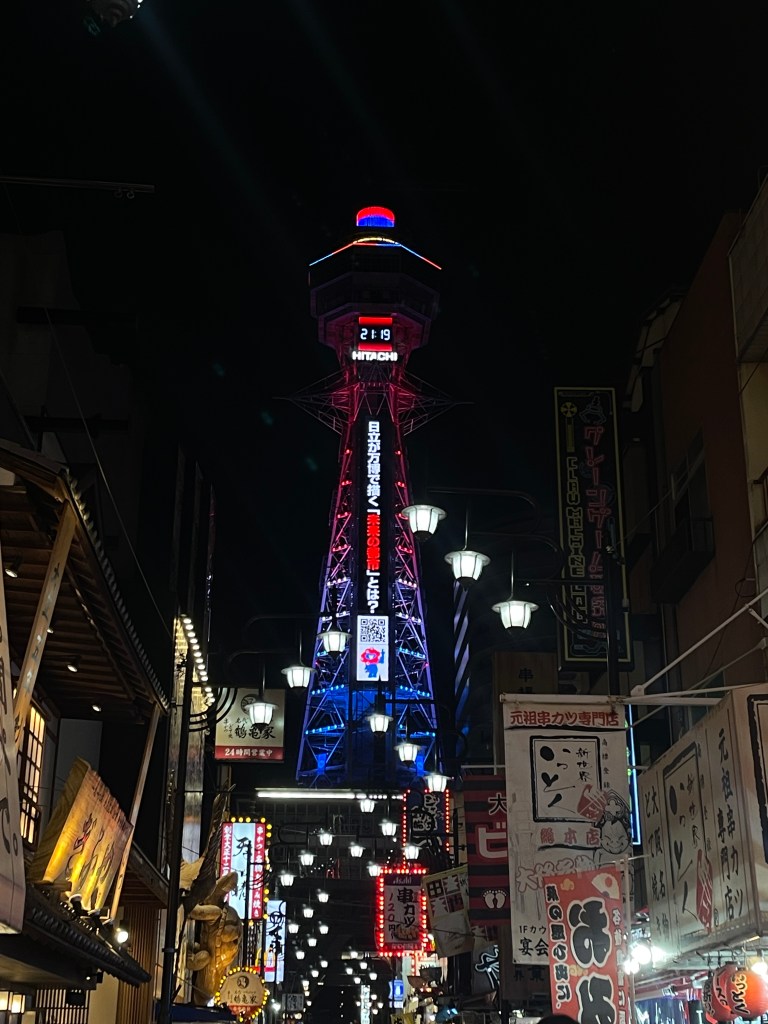
Including The 1903 Fifth National Industrial Exhibition, Osaka has hosted three major expositions in total. In that same year—1903, the very year that marks the first recorded arrival of Jeju haenyeo in Tsuruhashi—this site became a stage on which modern Japan showcased its latest technologies. Under the name “Human Pavilion,” Ainu, Koreans, Chinese, and Okinawans were put on display.
Today, Shinsekai is a chaotic landscape of takoyaki stands, kushikatsu shops, izakaya, pachinko parlors, and the oversized signs of Mega Don Quijote. Yet in the immediate aftermath of the exposition, Shinsekai was, true to its name, a “New World”—a successful model of Western imitation, filled with ornate attractions such as a carousel, a cable car, a music hall, and even an artificial waterfall valley.
After the war, as people gathered in search of work and labor demand surged during the reconstruction period, the population of neighboring Nishinari Ward grew rapidly. Yoseba—cheap lodging districts for single day laborers—spread densely across the area, and even today, the Airin district of Nishinari remains one of the places where such yoseba are most concentrated.
Then came the second exposition: the 1970 Osaka Expo. As the first large-scale world exposition in Asia, it brought an intense concentration of development and construction labor, further drawing in day laborers and solidifying a structure of low-wage work. In the shadow of Japan’s economic growth, the area experienced repeated tensions over labor conditions, gradually coming to be labeled a “slum” or a “dangerous neighborhood.” It was pushed to the margins as a space that sustained the spectacle of prosperity.
Although the area once known as Kamagasaki was officially renamed the Airin district, many who live there still use its former name.
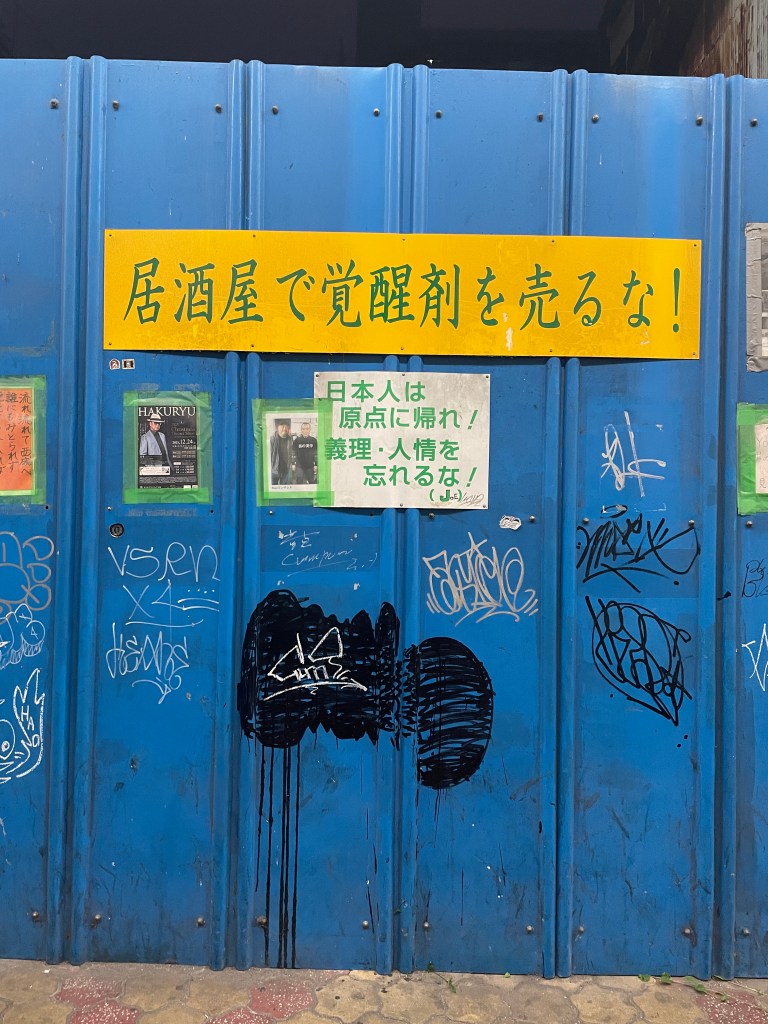
It says “Don’t sell drugs in izakaya!”
“Japanese people, return to your roots! Don’t forget loyalty and compassion!”
In truth, the reason I was able to come to Nishinari at all was because a teacher I trust told me that Cocoroom was a place I had to visit. I came here with them. One of my friends, who grew up in Osaka, told me they had never been here even once. I entered this place on borrowed trust.
During this visit to Osaka, I stayed at Cocoroom—eating and living together with the people there.
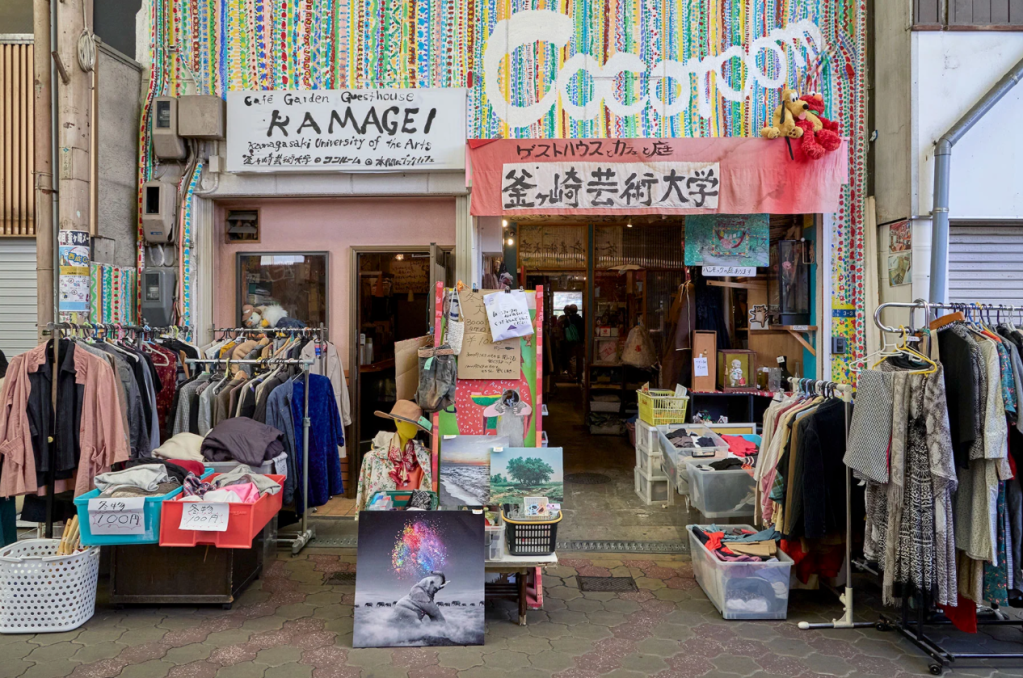
Source: Cocoroom website (https://cocoroom.org)
Cocoroom—
was harder to find than I expected.
Because it’s located within a shopping street, getting close wasn’t difficult. But it didn’t have the kind of entrance you would expect from a “guesthouse.” Instead, it looked more like a street stall, with various items laid out in front. I lingered there for a while, unsure. There were secondhand things, I think—clothes, cups, books, small objects.
Everything… was there.
And yet it was hard to tell, at a glance, what kind of place it actually was. Because it resisted categorization, because it was simply “there,” it didn’t feel like a place organized for efficient exchange or preservation of things.
I stood there for a while, hesitating—
Here?
And then I spotted the word “Cocoroom” and stepped inside.
A table.
A café?
But also a guesthouse.
But…
people cook and eat together.
That kind of place.
There is a small garden, and a well. The well, I was told, was built together by people in the neighborhood when this place was first made.
Cocoroom first appeared in 2003 in Shinsekai, something like a café, and later moved to Kamagasaki in 2008, where it has now been operating for over two decades. At the time of its founding, it was called “Cocoroom: Archive of Voice and Language (こえとことばの資料室 ココルーム).”
It is also known as the “Kamagasaki University of the Arts.” But it is not a real university. (what is a “real” university, anyway?)
At Cocoroom, staff and visitors prepare meals together every day, eat together, and do the dishes together. During my stay, the Osaka Kansai International Art Festival was taking place nearby, and I met a Vietnamese artist who was staying here as part of a residency while also exhibiting work.
Those who apply can join a Nishinari tour led by the director, Kanayo—what is called the “Kamagasaki Art Tour.”
Below are fragments from the tour, recorded in photographs and notes.
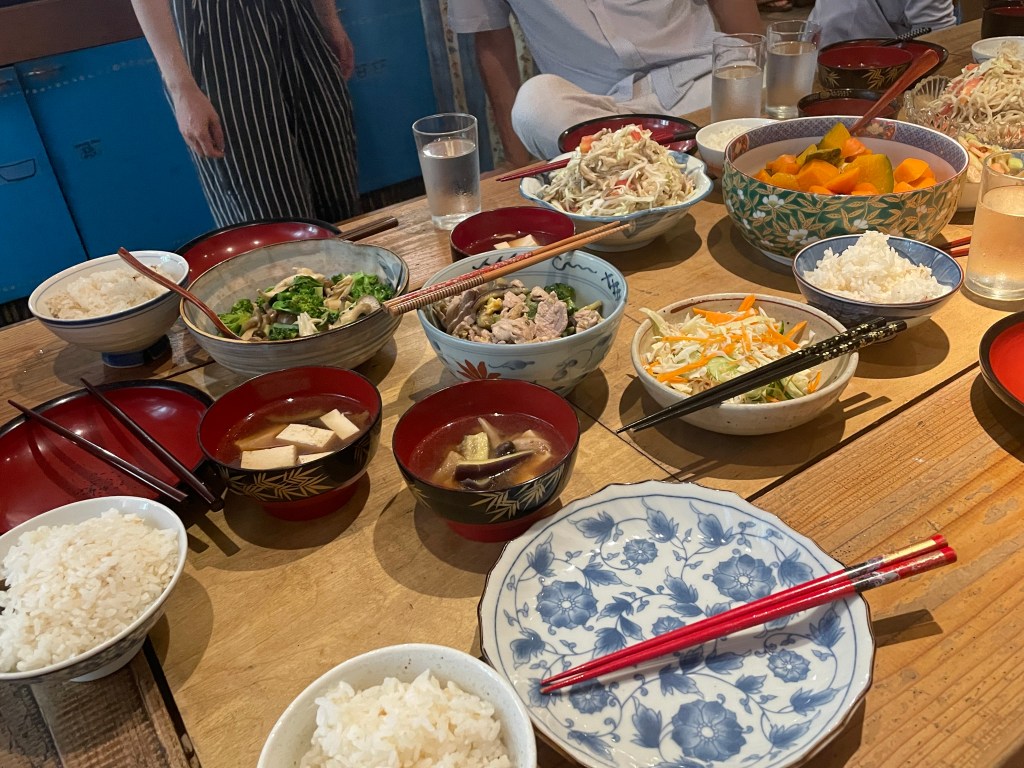
A donation of 1,200 yen is requested.
We prepare the meal together. We eat together. We clean up together.
The first thing I did, on my first visit, was to pair chopsticks and set them out.
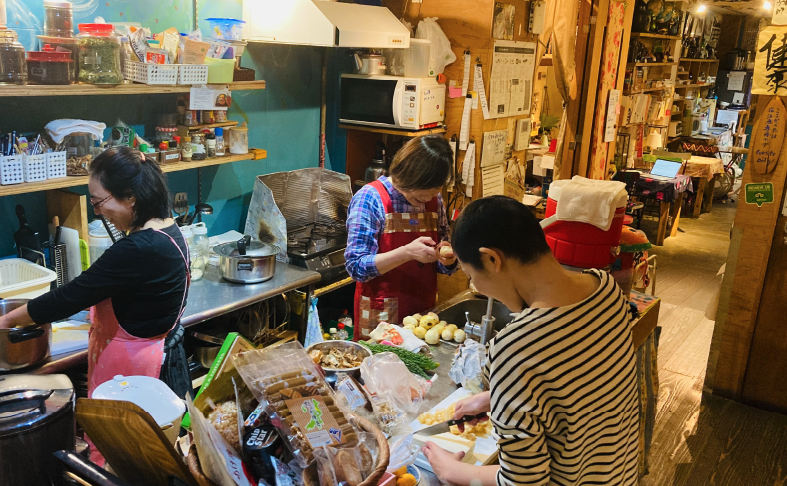
Source: Cocoroom website
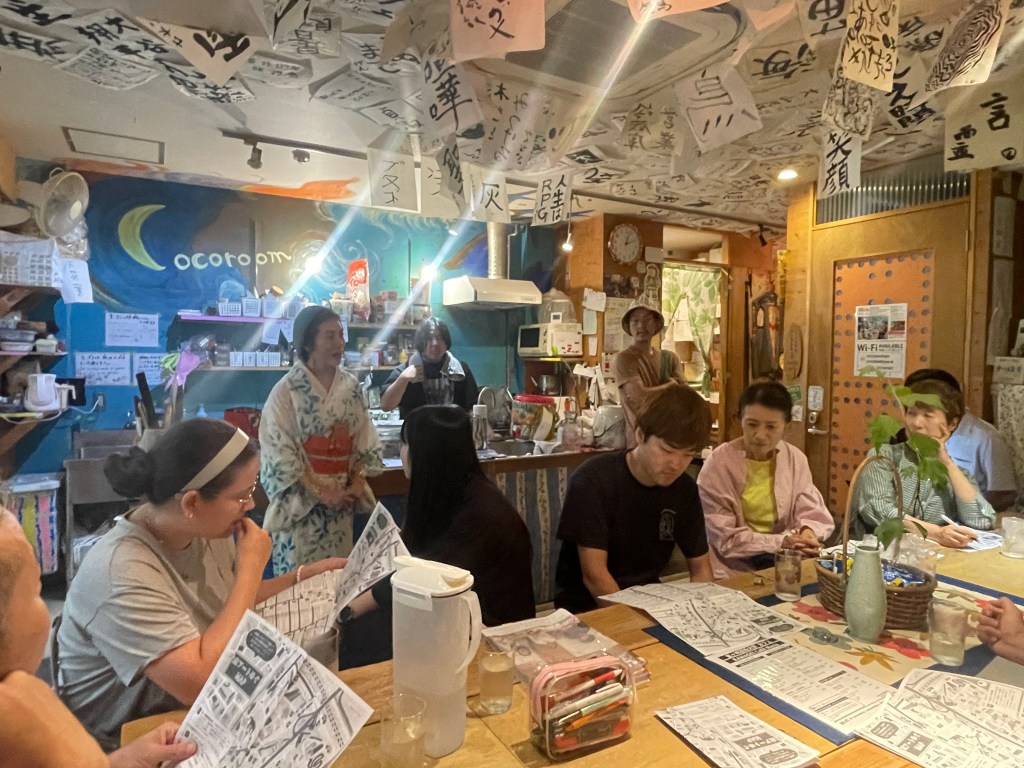
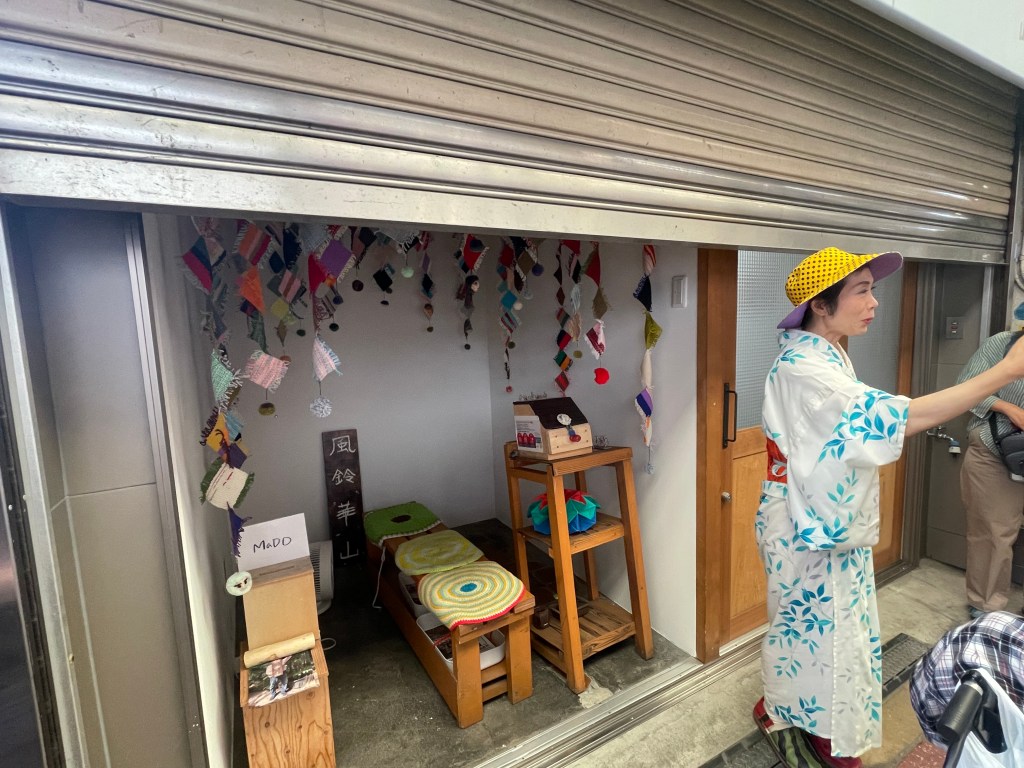
Converted from a bicycle parking space.
Chairs, cushions, ceiling decorations—all made by local residents.
Projects such as Bench Project are also ongoing.
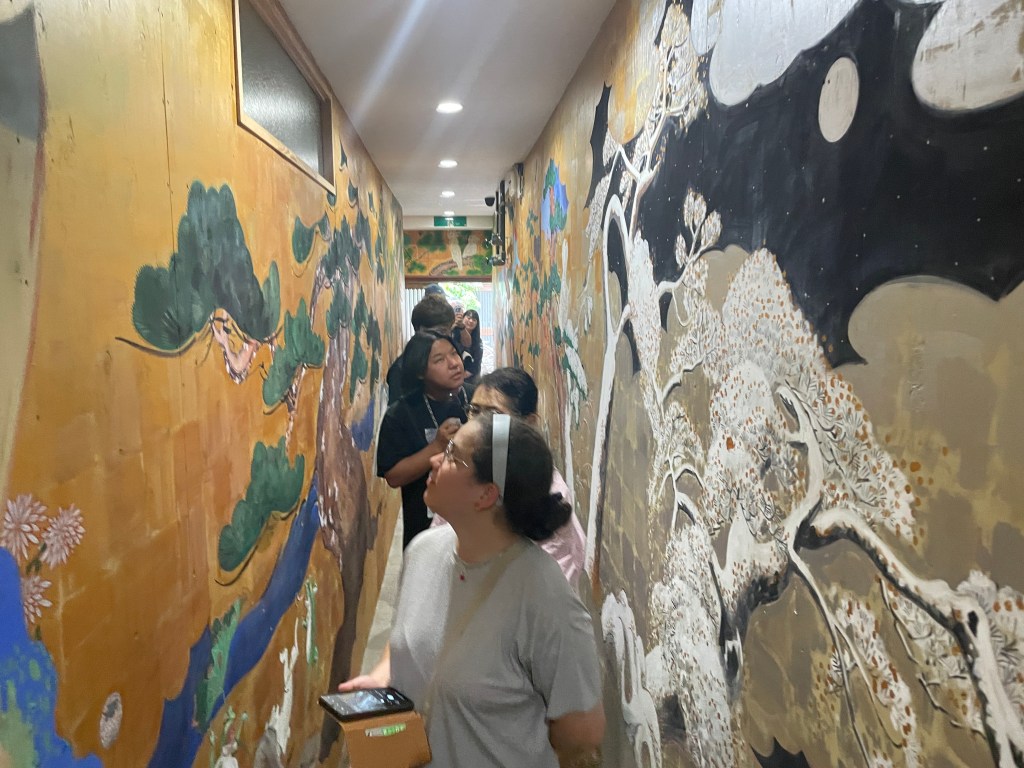
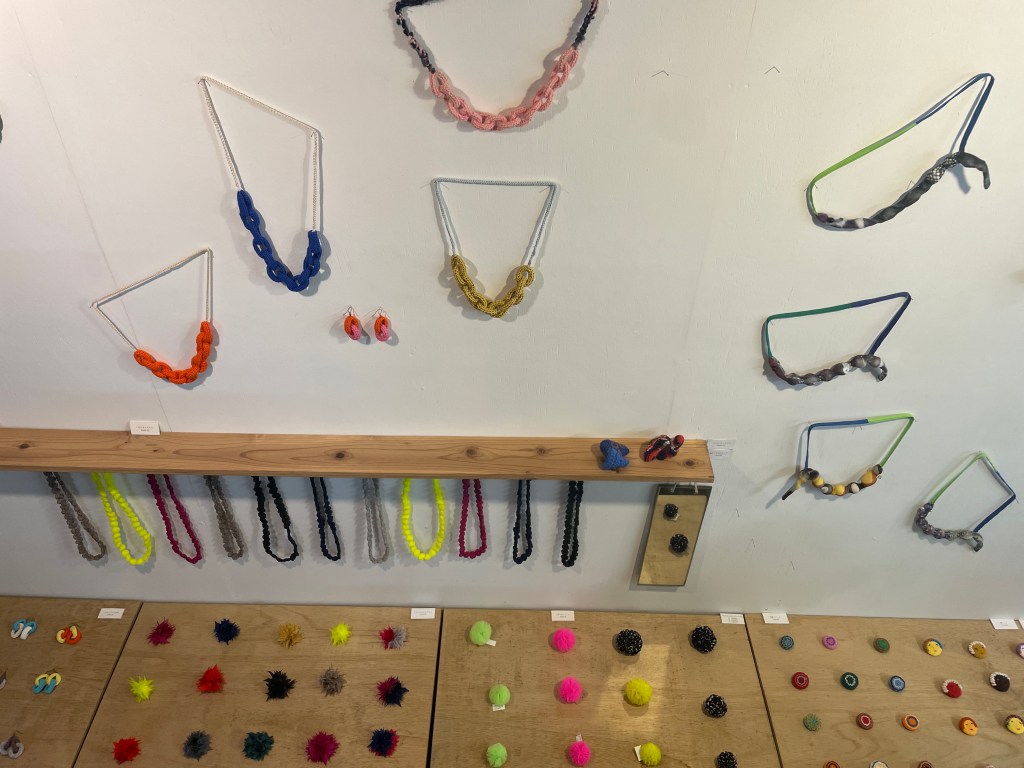
Originally a chest-of-drawers shop (たんす), it was transformed by the artist Yoshio Nishinari into a community-based fashion brand as an art project.
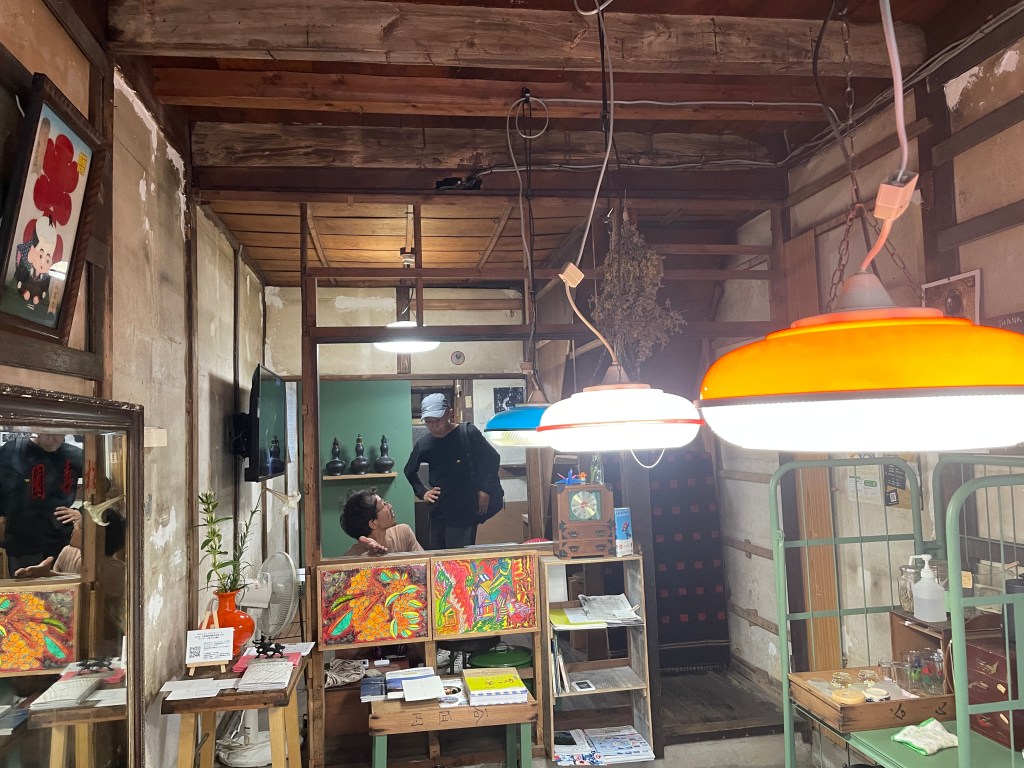
One work was installed inside Cocoroom, and at Café ATARIYA, an exhibition curated by Production Zomia was presented.
Work by the Vietnamese artist Linh San.
She was in Nishinari for a short-term residency, and I was able to hear her speak during an artist talk.
She made ceramics using fragments from Nishinari before returning home.
During the tour, I was also able to hear about Tobita Shinchi (飛田新地), located nearby. Relocated in 1912 after a fire destroyed the Shinchi brothel district in Osaka’s Namba area, it remained a large-scale red-light district (approximately 74,000 square meters) until the enforcement of the Anti-Prostitution Law in 1958. From the Edo period onward, Japan had regulated sex work through a licensed system, and Tobita Shinchi can be understood as one of its spatial embodiments. At the time, the district was enclosed by high walls, accessible only through designated entry points, and many women were bound by contractual arrangements that restricted their movement. It appears to have been structured around the idea of separating spaces of sex work from everyday residential life.
Today, some establishments continue to operate in the form of traditional-style restaurants, but Kanayo described the women there as being in the midst of a transition—seeking other forms of life, expression, and care.
Kamagasaki and Tobita Shinchi are within walking distance of each other. But rather than seeing them simply as geographically adjacent, I think they need to be read together through the lenses of labor and sexuality. Tobita Shinchi was not simply a site of sexual consumption; it likely functioned as a place that offered contact, recognition, and a sense of welcome after a day of labor. In this sense, it can be seen as a mechanism for the emotional and physical reproduction of labor power—a space that allowed workers to return, once again, to the conditions of work. In this way, the two districts were mutually implicated within the same labor system.
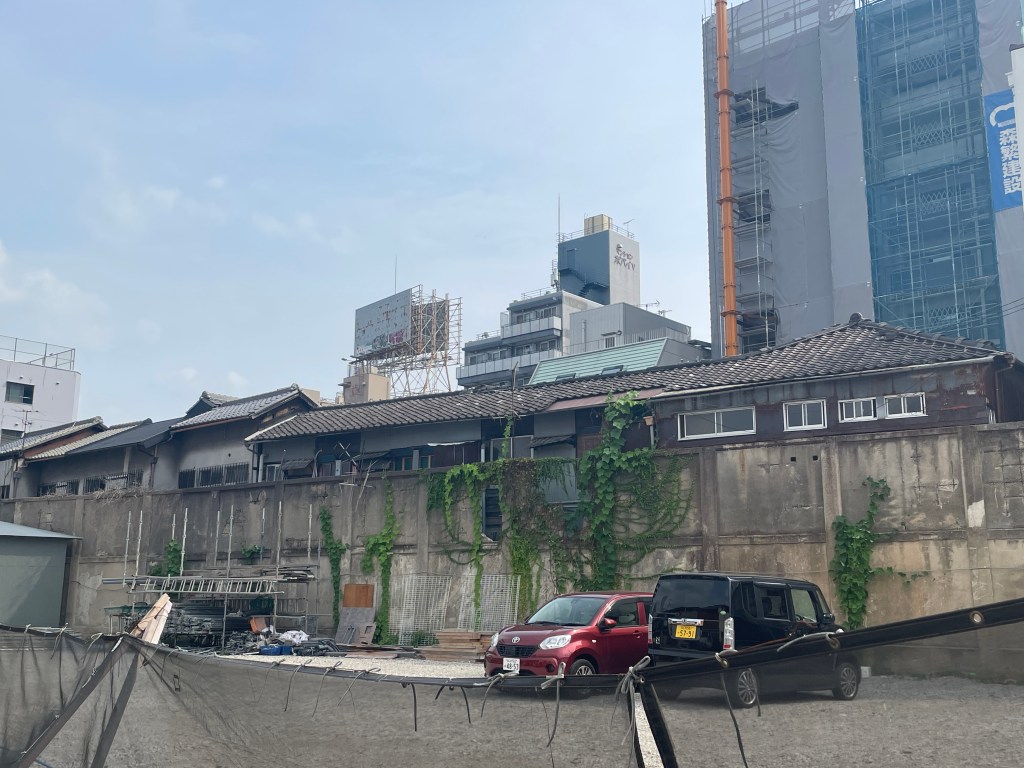
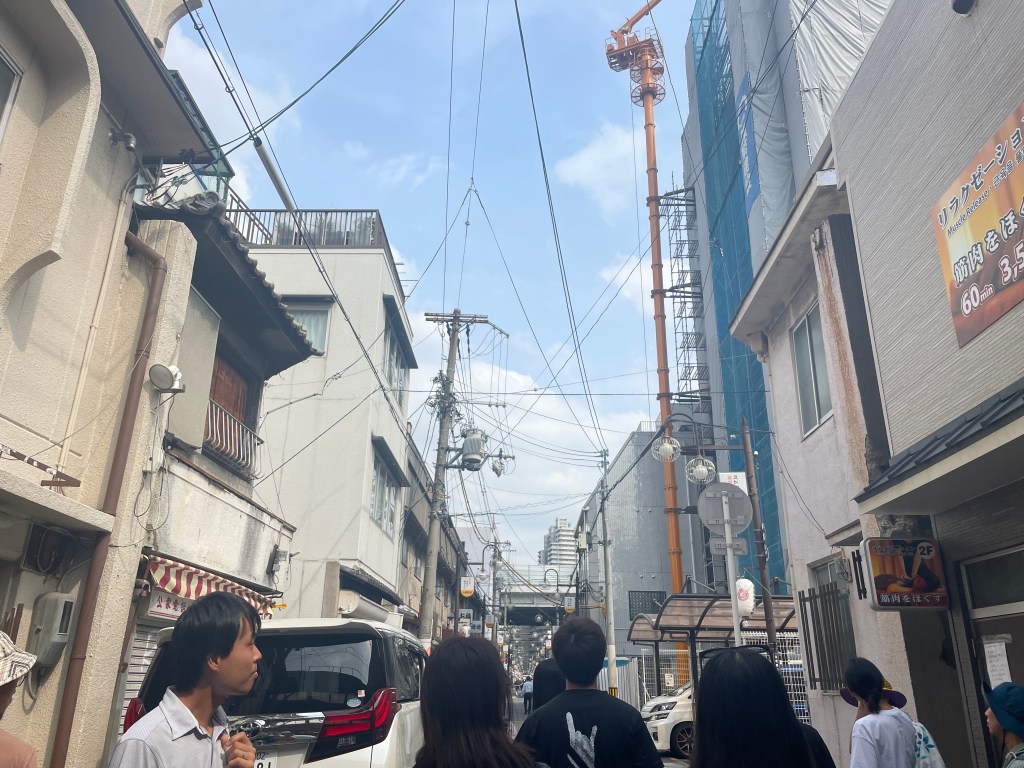
Nishinari—especially Kamagasaki—has functioned as one of the largest gathering sites for day laborers in Japan. And yet, despite the decisive role it played in supporting Japan during the period of high economic growth, the lives of individual workers have rarely been recorded. They remain only as nameless statistics, or as the representation of a “problem area.” Labor is central to the functioning of the city, but the lives of workers tend to slip out of institutional archives.
Cocoroom is run by Ueda Kanayo and a group of staff, including interns and volunteers.
Kanayo is a poet.
I know a little about women who write poetry. I studied creative writing; some of my friends are poets; I’ve learned how to write from poets. There is, among women poets, a certain kind of generosity—tinged with pain. One shouldn’t presume to speak for others, but I feel I recognize that kind of generosity. It is generous, and then even more so. The person themselves may be at ease, even happy, and yet, for those who watch, it leaves a small unease.
At Cocoroom, Kanayo continues to organize projects around what she calls “expression,” gathering people through various activities under the slogan: “To live is to express.” She uses the word “expression,” but not “poetry” or “art.” I have never seen a good poet among those who compel others to write poetry. Perhaps for that reason, I came to trust her, somehow.
When I sit in the lobby of Cocoroom, I find myself feeling that I should be helping with something. But no one asks me to do anything. It is open. There are no roles, no obligations. And yet, a strange sense of responsibility emerges. I can enter. I am not turned away. I can sit there, doing nothing. Sometimes, a resident with a disability comes in and speaks at length, alone. The staff respond—loosely, casually—but they do not send him away. They allow him to remain there. And when he says he is leaving, they say goodbye. It is very peaceful. It does not feel like someone is caring for someone else. They are simply there, in the same space. And then, when it is time to eat, everyone prepares the meal, eats, and cleans up together.
The day after I began staying at Cocoroom, I unexpectedly ran into an artist I knew. Osaka is such a large city, and yet. Because this place had felt somewhat isolated, the coincidence felt strangely out of place.
And, for some reason, I cannot clearly recall the faces of the people I shared the room with. I do not remember who was there, or who was not. Who left first, or who arrived. It feels as though no one had been there. Or as though we had exchanged lively greetings. Both seem possible.
On the last day, I went to Sankaku Park (Triangle Park) in the Airin district.
I had seen it before on YouTube. It is known as a central site of this neighborhood, where riots once took place. In recent years, more YouTubers have begun visiting Nishinari, repeatedly producing videos that take the surrounding landscape and poverty as their subject. I have watched such videos myself. Elderly people lying carelessly along the roadside. Drinks in vending machines all priced at 100 yen. Suspiciously cheap accommodations. Free food distribution. Those kinds of images. On my way there, I heard that as the everyday lives of homeless people and elderly laborers—especially around Sankaku Park—became subjects of filming, residents had grown increasingly sensitive to photography. Perhaps because of that, there is not a single photograph of the park on my iPhone.
Nishinari is no longer an “invisible” place. Rather, it may now be consumed as a place seen only in a particular way. Such visibility often does not reveal the complexity of lives or their historical context; instead, it tends to reproduce the image of a “problem area.” The more records and images accumulate, the more, paradoxically, life remains unrecorded.
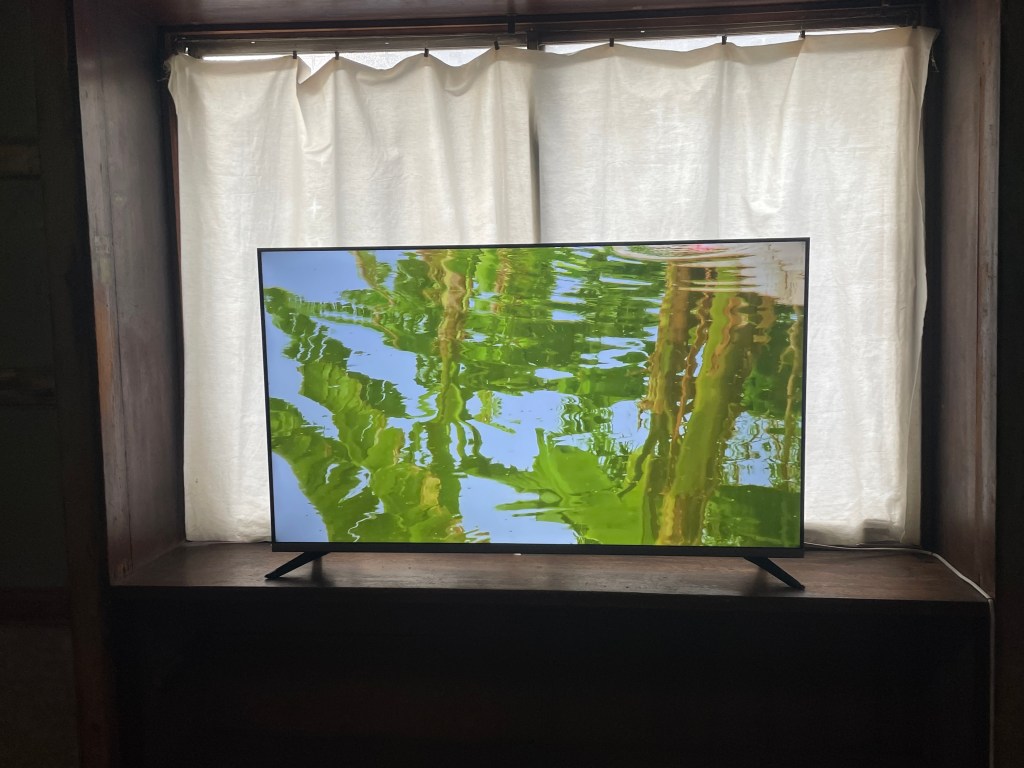
There was something I had been thinking about—a television I had seen in one YouTuber’s video of Sankaku Park. More than whether the area was “really like that,” the image that lingered was that strange scene: a television standing in the middle of the park like a utility pole. It felt absurd—a television in a run-down park—and yet, for some reason, I could not forget it.
Sankaku Park has a stage on one side. A pale, ochre-colored field, and scattered trees surrounding it. I was told that Kamagasaki University of the Arts (Cocoroom) holds a performance on this stage once a year. When I visited with my teachers, someone was sleeping beneath the stage, its roof worn down. In the middle of the field, there was also a television. It was covered. It seems it is only uncovered at certain times. While writing this, I looked it up, and found the following news:
“Street Television” Revived in Nishinari’s Airin District — Local Company Takes Over Management
Mainichi Shimbun, April 12, 2019, 19:49 (last updated 22:54)In the Airin district of Nishinari Ward, Osaka, a “street television” that had been enjoyed by workers as a form of entertainment for over half a century was revived on the 12th for the first time in about a year. The television had broken down in March of last year, and its future was uncertain, with the Nishinari Police Station of the Osaka Prefectural Police even considering its removal. However, a local company has taken over its management and installed a new television.
Under the trees in the park, a few people were grilling meat. It smelled good. It was the first time I had seen a scene like that in a park in Japan. Wearing worn clothes, looking a little fragile, they laughed as they ate. Among them was one man who did not seem to belong to this town, and yet somehow appeared to blend into its air—a Black man. When he saw us, he waved exaggeratedly and shouted, “Hey, where are you from!” He smiled so brightly that I could clearly see his missing teeth, his gums exposed. For a moment, I hesitated over whether to respond, and ended up passing by with only a faint smile. I still don’t know if that was the right response.
The fact that this town did not reject me made me hesitate even more.
At the same time, Nishinari is also entering a new phase of change, shaped by an aging population and the influx of migrant communities. Recently, Chinese-style religious facilities have appeared, and migrants of various nationalities have begun to settle here, living alongside long-term residents. There is another story I heard about the Airin district: in the past, people with Hansen’s disease would often come here. The reason was simple—no one looked at them as strange.
—
In Tsuruhashi, memories that someone had tried to preserve were arranged—together with their absences—through the language of institutions. What was collected? What was exhibited? What was left out? In Nishinari, lives that no one had tried to preserve remained simply where they were. Some forms of memory, precisely because they are not absorbed into institutional display, remain in the present tense. Rather than being explained or interpreted, they continue through repeated actions, through speech, through the forming of relationships, through the habits and rhythms of the body. Such memories do not become fixed like specimens; they recur, again and again, remaining unfinished.
In these two places, I found myself asking the same question twice: what kind of memories am I someone who is allowed to speak before? The words I use. The thoughts I form.
What is it that can be done?
Who is granted the right to be remembered, and who is able to leave something behind?
Even now, I still do not know whether I am someone who is allowed to speak in front of certain memories. Between unrecorded faces, nameless statistics, and lives no one leaves behind, I find myself hesitating. In Tsuruhashi and Nishinari, I saw what is lost when memory enters institutions, and what remains when it stays outside them. Somewhere between the two, perhaps, lies the name of my grandmother, which I do not know. There are parts of her life with no record. No institution. No public language. And yet, they do not disappear from within me.
Is it possible for a memory to remain,
even if one has never been there?
For some reason, I find myself increasingly held by scenes I have never seen.
That memories I have never experienced come to matter to me.
This text is less a record meant to preserve something than an attempt to pause somewhere within memory.
Some lives leave only an arrival; others leave only a passage, without a known beginning or end.
At Cocoroom, every morning we stepped out into the arcade shopping street and did exercises together. A song—someone had written it for Cocoroom—would play as we faced one another, stretching our arms and legs, hopping lightly in place, spinning around. When people passed by, we greeted them. This is the memory I like most. In that moment, the feeling of being an outsider grew just a little fainter.
No—
perhaps the reason I liked that memory most was simply because we said hello.
The Airin district was quieter than I had expected.
At night, it was frightening.
Like a dark sea I once saw long ago—
or perhaps one that others had seen.

